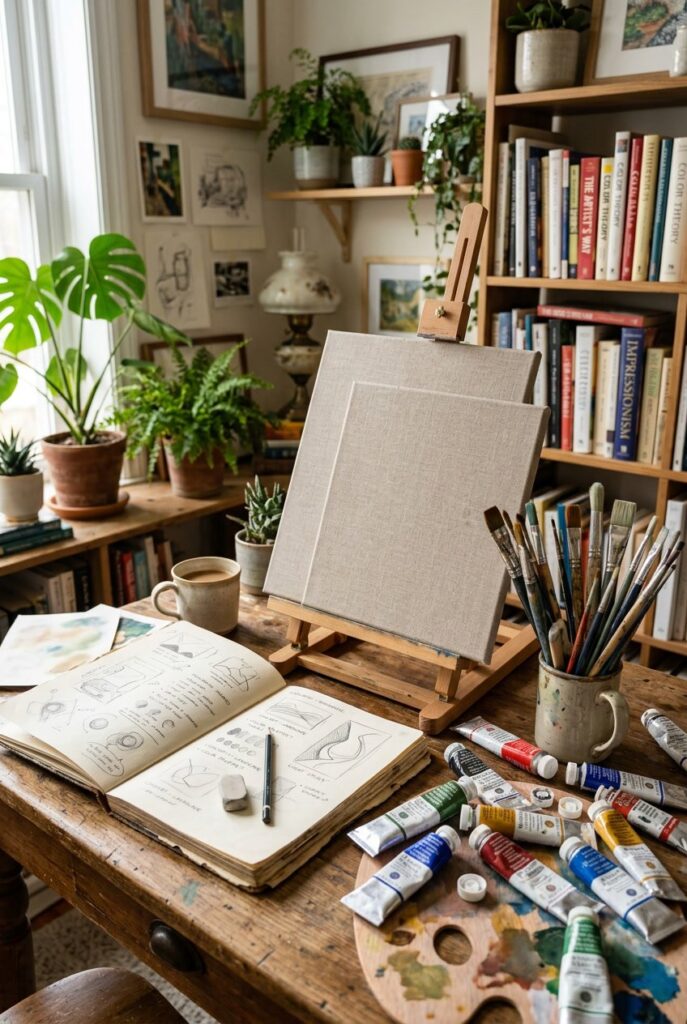
You can always fight a blank page, but it’s easier to start with an easy target. So instead of wrestling with the whole page at once, start with a simple goal and work your way up to it. A simple idea with a few simple lines and words can be a good starting point. Choose one focus for your drawing and practice some drawing skills and value studies while keeping your main goal in mind. Do you want to practice a new skill, convey a certain feeling or just see where things go? Make some time to just play with the media and let yourself relax and be creative.
Time to move on to your next exercise! Choose a quick simple subject. An example might be a view from a window, a snack or even a simple color study. Then simply paint for as long an interval of time as you choose, anywhere from 20 to 40 minutes. One rule is sufficient to get you in the right mode and yet still in control of your experience.
Looking for something a bit more challenging than simply practicing? Try replacing one ingredient, or switching to a different color palette, or change the lighting or even re-do an earlier exercise.
Its simpler to learn when we have fewer choices. We like to think of it as a simple rule: work on only one technique or feeling per practice and limit the number of choices you have. Experiment with the approach and see what you notice.
Key Takeaways
- Pick a simple, specific prompt and paint without judging.
- Limit choices to focus on one goal or technique.
- Small, timed sessions build habit and spark new ideas.
Understanding Why You Feel Stuck
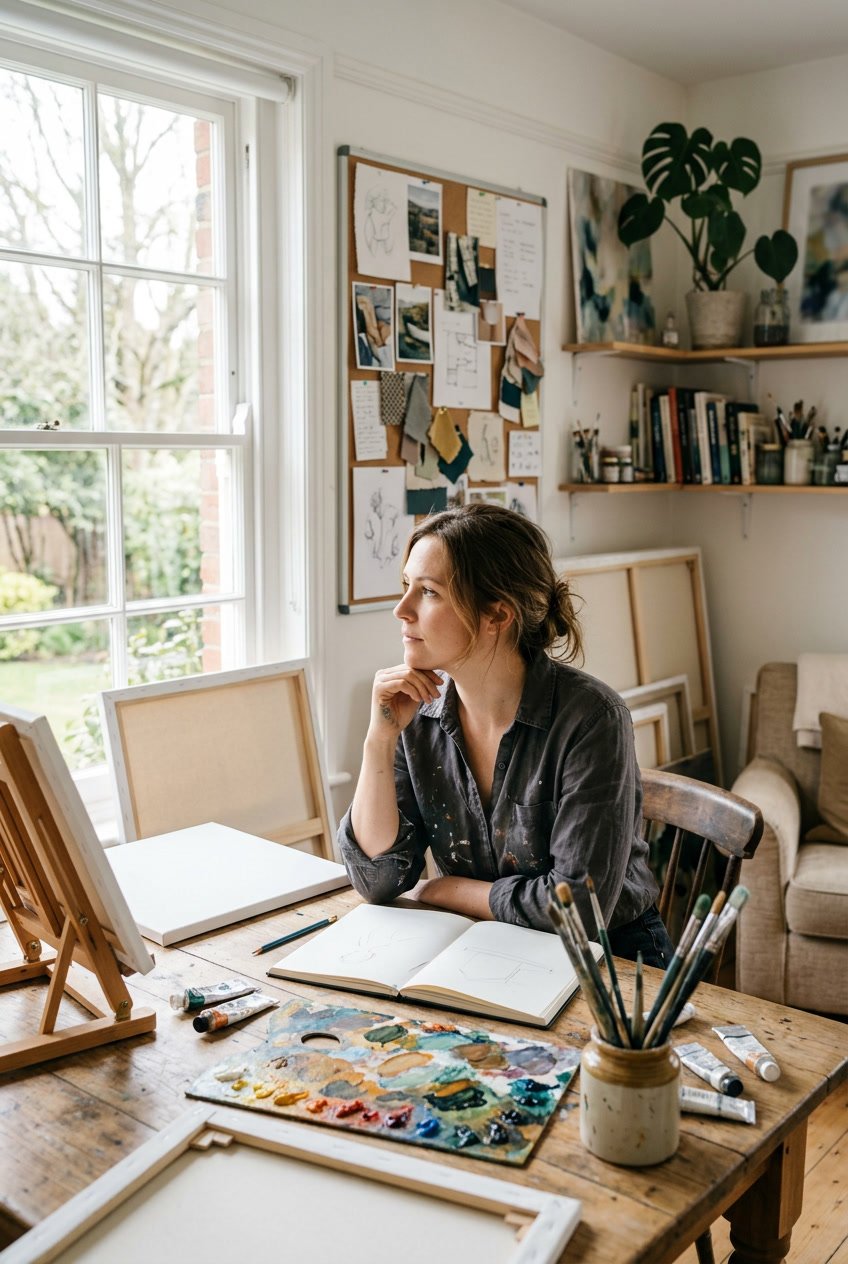
I reckon you might be unintentionally blocking your own path to progress, possibly because you’ve got a number of behaviours, drivers or objectives that are interacting with each other in ways which create obstruction. In most cases, it’s an easy thing to spot, but you may need to have a bit of a think about what’s happening, make a small change to one of your routines and simply start with a tiny step.
Common Creative Blocks
Here are some Blocks that can get in the way of painting. Sometimes we have these Blocks because of fear, overwhelm, or low energy. We may be afraid to even start to paint because our mind starts worrying about all the possible ways our painting might not turn out well. We might feel overwhelmed because there are so many choices for how to proceed. Or we might lack the energy we need to take the first step, or any of the subsequent steps needed to finish a painting.
Too many options scatter your focus. You keep switching ideas instead of finishing one.
Exhaustion and fatigue can be quite draining. When we’re feeling really fatigued, it can feel like we’re not able to function. Fatigue impacts our ability to concentrate and do the things we need to do in our day to day lives. Some days it feels like even the most basic of tasks are very hard to accomplish. Decisions become a real challenge to make.
TRICK ALERT Do you: – delay starting to set up because you aren’t quite ready yet – erase drawings or paintings because they aren’t perfect – shut down your art when you are really getting into it There are now quick fixes for each of these bad habits. You can choose one, or more, of the following options: – Choose from three presets to limit your setup options – Turn on a 20 minute drawing rule to prevent over-planning and starting over – Turn on painting to your creative peak, to help you stay in the flow of the moment.
Mindset and Expectations
Expectations are the things that paint themselves in the back of your mind. And if you expect perfection then you’ll spend all your time tweaking the start of the painting rather than letting it carry on.
Expecting instant inspiration? Suddenly, ordinary moments don’t feel worth painting.
WORKING BLOCS Experiment with lower standards. Your real work deserves your best standards.
We need to change how we speak to ourselves in our head. Instead of saying to ourselves “I MUST MAKE A MASTERPIECE!” try instead saying “I will learn a lot from this exam, whatever the results will be! “.
Track one clear goal per session—maybe it’s edges, light, or a palette. Concrete goals shrink anxiety and make picking a subject way easier.
Embracing the Artistic Process
Treat painting as a string of small steps, not a single leap. Start with warm-up marks, a quick value study, or a five-minute thumbnail.
These tiny tasks shift your brain into doing mode and take the pressure off the outcome.
Set up routines that keep you moving: a short setup ritual, a fixed time block, a place to stash unfinished pieces. Use prompts or constraints—a single color, one object, or a 30-minute limit—to force decisions.
Keep a log of what you tried and what got better. Seeing progress on paper builds confidence.
Quick Ways to Generate Painting Ideas
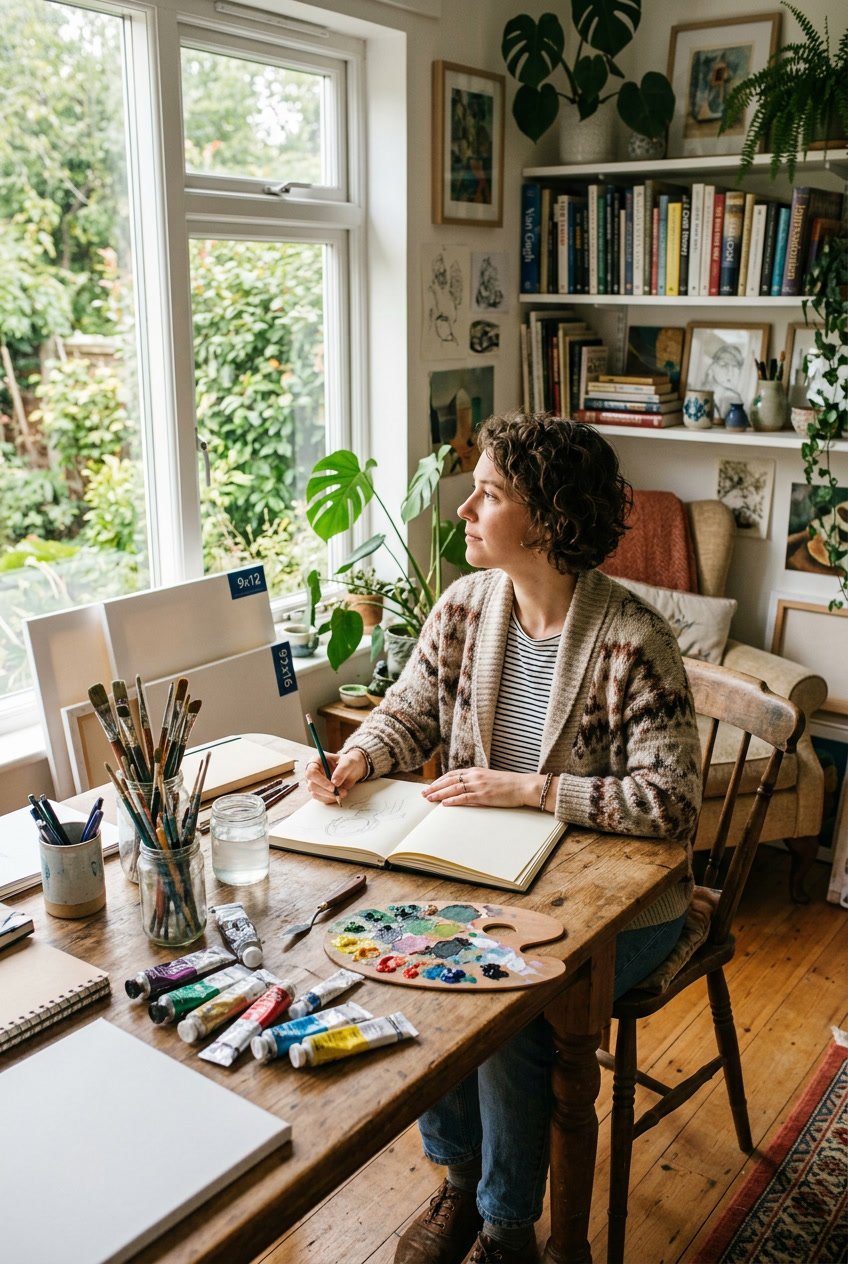
Find fast, practical prompts that get you painting now. Simple subjects, small experiments, and easy research can turn a blank canvas into something finished.
Everyday Objects for Inspiration
Look around your home for things to paint—a coffee mug, houseplant, pair of shoes, or a stack of books. Pick one object and study its shape, color, and light for 15–30 minutes.
Try three quick variations: realistic, simplified shapes, and a color-only study.
Set up a small still life with 2–4 items that contrast in texture—maybe a metal spoon, soft cloth, or glossy fruit. Use a single light source to create strong shadows you can exaggerate or soften.
Snap a photo or two from different angles so you can paint even when the light changes.
Write a list of 20 items in one sitting. Use it as a week-long prompt plan—paint one item a day, or combine two into a single piece for new ideas.
Nature and Outdoor Scenes
Step outside and focus on a single patch of nature—a tree branch, puddle reflections, or a stone wall. Paint quick studies at different times—morning, midday, evening—to see how light shifts color.
Keep your palette small to zero in on form and value.
Weather makes great prompts: fog simplifies shapes, rain gives reflections, and bright sun throws crisp shadows.
Take reference photos but try quick thumbnails or a five-minute plein air sketch first.
Pick a local spot you pass often—a park bench, corner street, or a window view—and paint it over and over. Little changes in season or angle give you endless new ideas.
Memories and Personal Stories
Pick a memory with strong visuals—an old bicycle, childhood kitchen, or family picnic. Jot down three concrete images from that memory: colors, objects, a small action.
Use those details for your composition.
Change the emotion by tweaking color or style. Paint the same memory realistically, then again with two color swaps or as a looser, expressive piece.
That way, you get several paintings from one story.
Try the memory-box method: collect three keepsakes, arrange them, and paint them together. Add a background that hints at time or place but skip the extra detail.
Browsing Art Communities and Books
Scan art communities for focused prompts—challenge threads, weekly themes, step-by-step demos. Save images that grab you and jot down what you like: palette, composition, subject.
Rework those elements into your own idea instead of copying.
Flip through books and magazines for concrete prompts: a portrait technique chapter can spark a model study, a landscape spread might lead to a color study.
Make a simple prompt card: “Subject + Mood + Constraint” (like “apple + dusk + three colors”) and pull one when you’re stuck.
Follow a few artists you respect and try one experiment inspired by each every week. That steady stream of ideas helps you find what you love to paint.
Easy Painting Subjects for Beginners
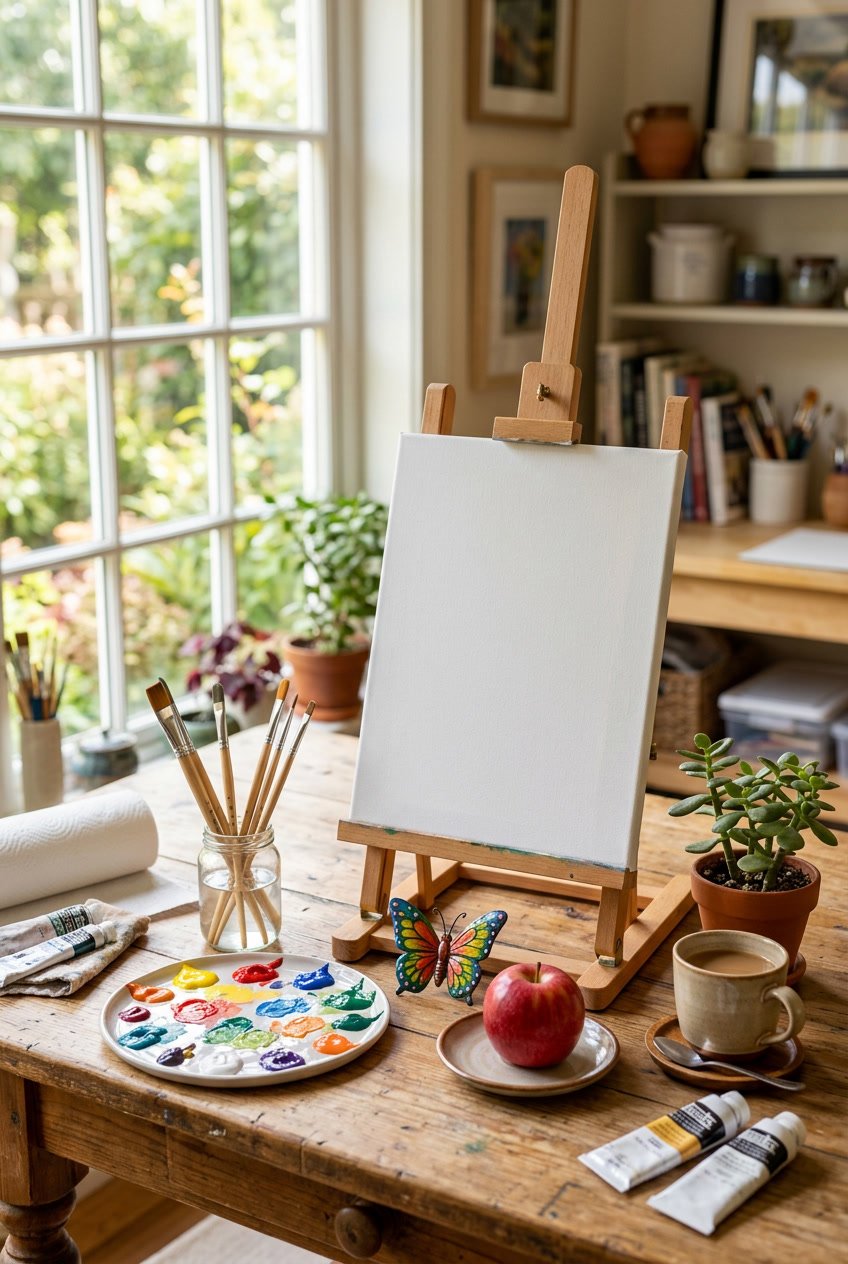
You’ll find low-pressure subjects that teach basics like shape, value, and color without demanding detail. Pick items that let you practice brushes, blending, and composition quickly.
Simple Still Life Arrangements
Pick 3–5 objects with clear shapes—a mug, apple, bottle, folded cloth. Arrange them with space so each silhouette stands out.
Use one light source (lamp or window) to create clear shadows and highlights. That helps you learn value—the darks and lights—without getting lost in tiny detail.
Start with a quick pencil sketch, then block in big color areas. Focus on edges: hard for mugs, soft where cloth folds.
Limit your palette to 3–4 colors to keep things clean. Paint the same setup in different lighting to see how color and shadow shift.
Beginner-Friendly Landscapes
Choose simple scenes nearby—a field with a tree, calm lake, or distant hills. Work from a photo or look outside.
Paint in layers: sky first, middle ground next, foreground last. This builds depth but keeps each step easy.
Use big brushes for broad shapes, a small one for a tree silhouette or shoreline. Don’t try for every leaf or blade—just catch the main masses of light and dark.
Try a sunset gradient with a dark silhouette in front. It teaches contrast and keeps details minimal.
Practice one-point perspective with a road or fence to learn space.
Playing With Abstract Forms and Color
Divide your canvas into blocks, circles, or overlap shapes. Masking tape gives sharp edges; freehand feels softer.
Abstracts let you play with color mixing, harmony, and balance without copying reality.
Pick a small palette—three colors plus white—and explore tints and shades. Try textures: scrape paint, dry brush, or sprinkle salt into wet washes.
Keep these pieces quick—set a 20–30 minute timer to force bold choices. Abstracts teach you composition, value contrast, and confident brushwork that carry into other work.
Animals and Pets
Start with simple silhouettes—a curled cat, sitting dog, or bird on a branch. Focus on shape and posture before fur or feathers.
Use reference photos taken at eye level for easier proportions.
Break the animal into basic shapes—ovals for body, circles for head—and block in midtones. Add shadows and highlights to suggest form, not every hair.
For pets, catch a strong pose or expression—one clear eye, the curve of a back. Paint small, fast studies (10–30 minutes) to build speed and confidence before tackling longer pieces.
Exploring Painting Techniques
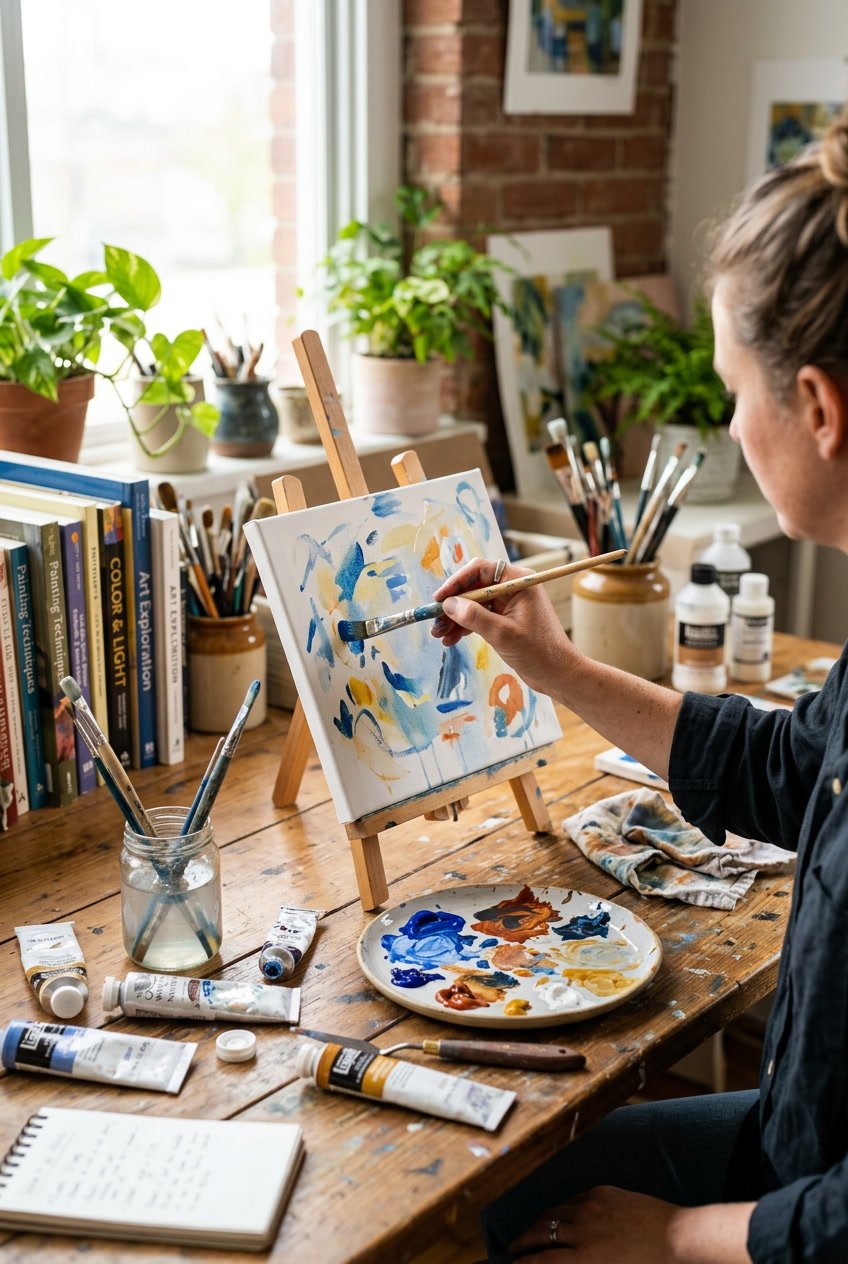
Try methods that help you make strong choices fast. Each technique gives you a clear rule to follow so you can start painting without overthinking color or subject.
Trying a Limited Color Palette
Pick 3–5 colors before you start and stick with them. Choose a primary, a supporting mid-tone, and a dark or light for contrast.
This keeps your paintings unified and takes away the stress of endless color decisions.
Mix those colors for tints and shades. Add white for pastels or mix with a neutral for muted tones.
Test small swatches on scrap paper to see how the mixes look together.
Use one color for focal elements, another for background or shadows. That helps the main subject pop, even if your drawing is simple.
Limited palettes work for landscapes, portraits, and abstracts.
Experimenting With Pour Painting
Thin acrylics with pouring medium until they’re honey-like. Pouring is simple—flip cup, dirty pour, or swipe—to make fluid shapes and cells without detailed brushwork.
Prep your workspace with a level surface and catch trays. It gets messy.
Control comes from viscosity and silicone drops. Thicker mixes hold shape; thinner ones flow more.
Add a few silicone drops for cell patterns, then tilt the panel to move the paint. Let pieces dry flat for at least a day or two.
Treat pour painting as a string of experiments. Jot down ratios and results so you can repeat effects you like.
Use small panels to practice before going big.
Mixed Media and Unusual Tools
Mix paint with ink, collage, or texture paste to change the look quickly. For texture, spread modeling paste with a palette knife or stencil for raised patterns.
Once dry, paint over it to pop shadows and highlights.
Try odd tools: credit cards for scraping, sponges for mottled effects, toothbrushes for splatter, Q-tips for tiny dots. Each tool leaves a different mark and can rescue a blank surface when you’re stuck.
Layering matters. Start broad and loose, then add tighter details on top.
If a layer flops, sand or paint over it. Sometimes mistakes turn into features by changing scale, color, or texture.
Challenging Yourself With New Types of Painting
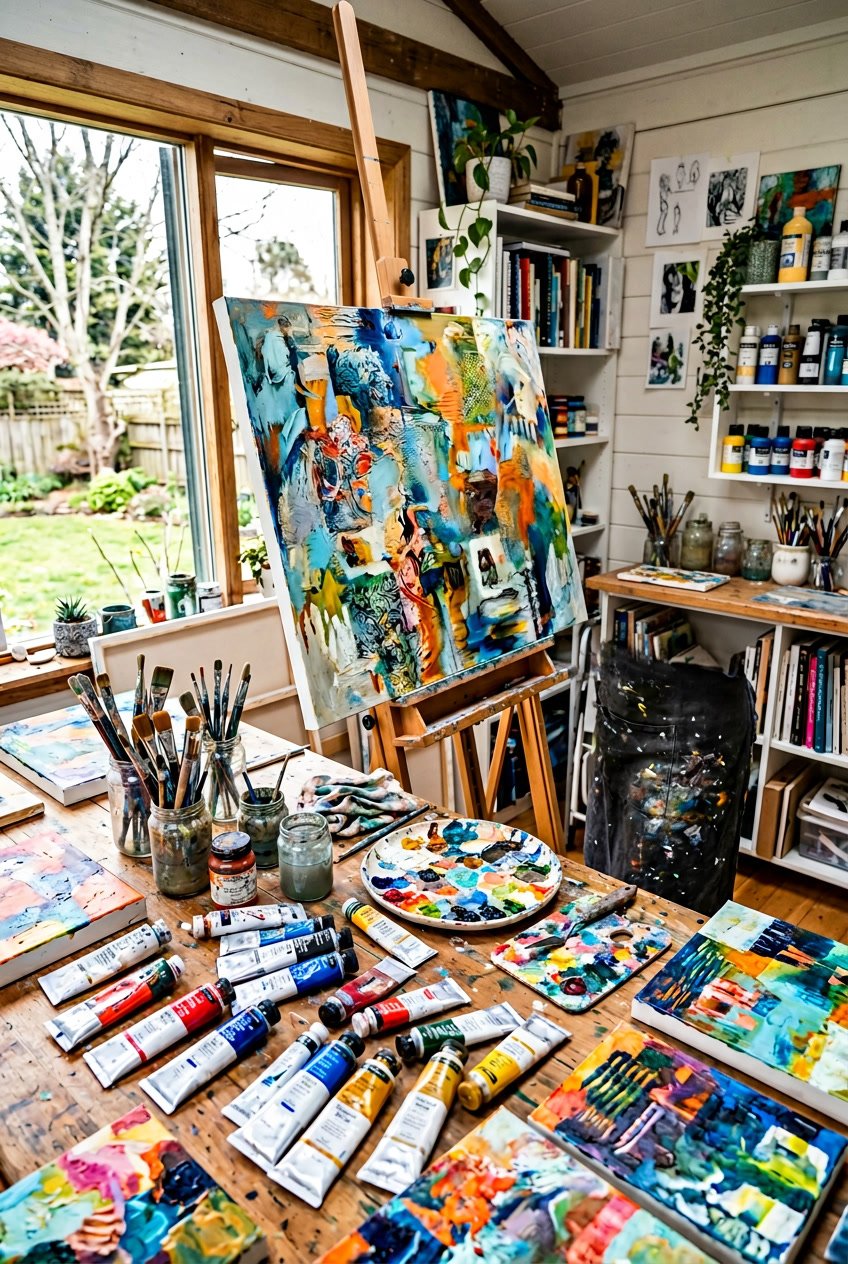
Push your skills with concrete methods: pick a single face, a full figure pose, or an emotion to express with color and mark-making. Use limited palettes, timed sessions, and focused studies to build control and confidence.
Starting a Portrait Painting
Find a clear reference photo with good lighting and a simple background. Start by mapping proportions: mark the head oval, horizontal eye line, and vertical center.
Use light pencil or thin paint to place main features before locking in values.
Block in big shapes first—forehead, cheeks, jaw—using midtones. Add shadows and highlights to model form.
Eyes and mouth anchor the likeness. Work in layers: thin underpainting for tone, thicker strokes for texture and detail.
Try a limited palette (like titanium white, burnt sienna, ultramarine) to learn value and color mixing.
Step back often and compare left-to-right for symmetry. If the likeness feels off, check distances—eyes to nose, nose to chin.
Practice quick 20–30 minute portraits to build speed and decision-making.
Capturing the Human Figure
Start with gesture drawings to grab the pose and energy right away. Spend just 1–5 minutes per sketch, focusing on the spine line, where the weight sits, and how the limbs move.
These loose studies make later painting feel way more dynamic. For a finished figure, break things down into basic forms—cylinders for arms, boxes for the torso, spheres for the joints.
Block in the big areas of light and shadow before you get lost in muscle or clothing details. Watch how the light wraps around forms; painted edges shift from hard to soft as distance and lighting change.
Use proportion rules like the head-count trick (adults are about 7–8 heads tall) to check your scale. Try cropping your compositions or picking weird viewpoints just to shake things up.
If you’re working from a model, swap up the poses and try a few short, timed sketches. That’ll sharpen your eye and keep your energy up.
Abstract Emotion and Expression
Pick one emotion and give it a palette and mark language. Say you’re painting anger—try saturated reds and jagged strokes. For sadness, maybe muted blues and softer washes.
Define a handful of gestures to repeat across the canvas. Focus more on composition and contrast than on literal shapes.
Grab texture tools—palette knife, rags, sponges—to add some tactile interest. Layer colors, then scrape back to reveal what’s underneath. Sometimes, that creates depth and surprises you with strange color mixes.
Set a few constraints: maybe use only two colors, or don’t touch a brush for one piece. These limits force your hand in good ways and help you find new tricks.
Keep quick notes on which marks or color mixes really nail the emotion. That way, you can build your own visual language over time.
Building Consistent Inspiration Habits
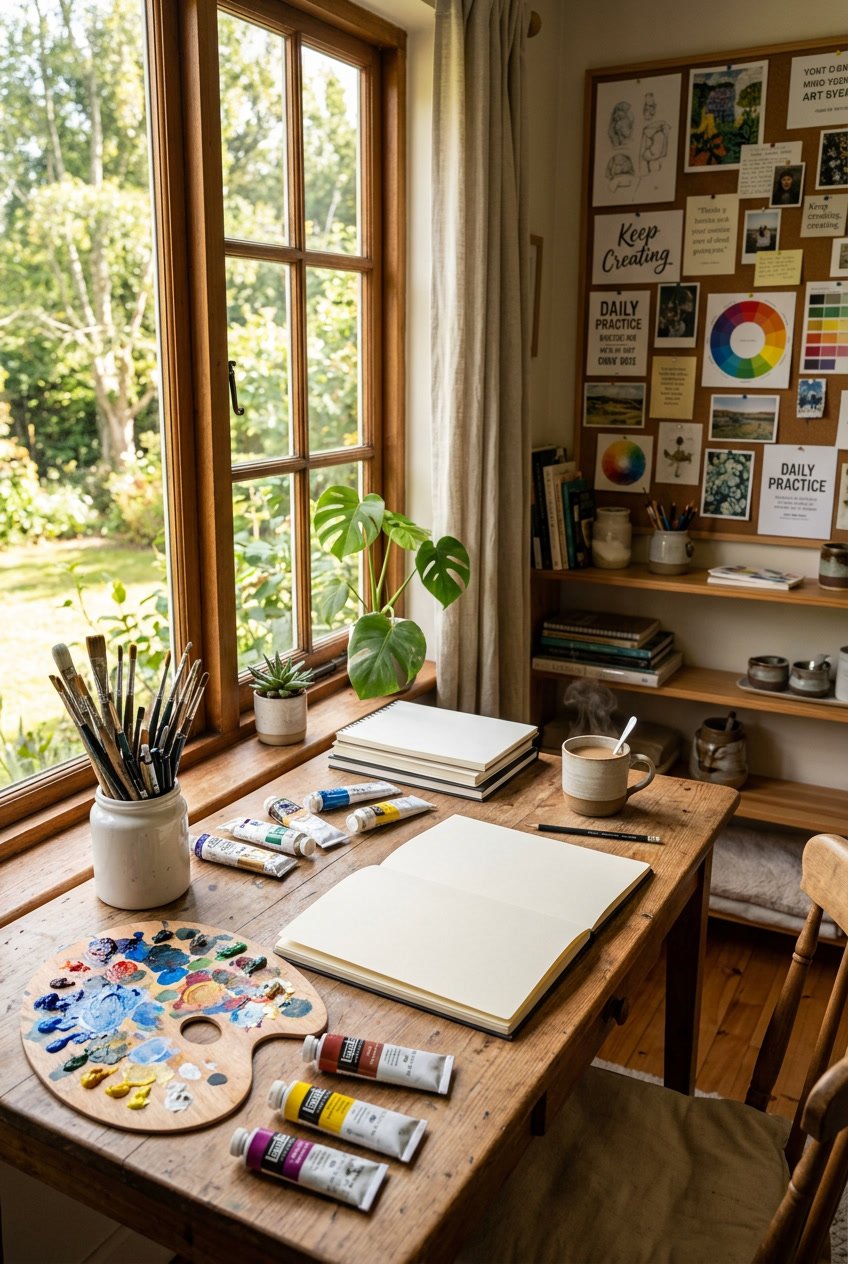
You can build steady inspiration by leaning into social learning, daily prompts, and reusing old work. Each habit gives you something to do: join groups, follow challenges, remix your own stuff, and see what new ideas pop up.
Joining Art Classes and Groups
Jumping into local art classes or online groups gives you feedback and deadlines. That alone keeps you painting. Look for classes that meet weekly and focus on skills you actually want—color mixing, composition, figure painting, whatever you’re into.
Small classes or critique groups get you focused advice and push you through creative ruts. Use community channels to share your work and ask for quick prompts.
Join at least one active Discord, subreddit, or Facebook group. Post a weekly progress shot—treat it like a deadline. You’ll find painting ideas show up when you have to share something.
When picking a class, check the syllabus. Go for instructors who give real assignments and demos. For painting ideas, classes that include still life, landscape, and study exercises will keep you stocked with new subjects.
Using Prompts and Creative Challenges
Daily and weekly prompts make you start painting instead of waiting for inspiration. Use prompt lists—color, object, mood—and set a short timer, like 30 to 60 minutes, for a painting or sketch.
Time limits stop you from overthinking. Try these prompt tricks:
- Random object jar: pull a slip with something to paint.
- Color-first prompt: pick two colors and build a subject around them.
- Theme weeks: spend seven days on “plants,” “kitchen tools,” or “portraits.”
Jump into month-long challenges like “30 paintings in 30 days” or prompt calendars. Public accountability and all those new subjects help you build a daily habit.
Documenting and Remixing Old Work
Keep a simple archive of sketches and finished pieces. Photograph or scan your work, then tag files by subject, color palette, or technique.
When you’re stuck, open your archive and pick a tag. That gives you a concrete place to start.
Remix by changing scale, palette, or medium. Blow up a small sketch into a big acrylic, or turn a still life into an abstract. Mash up two old ideas—maybe a plant study and a portrait—to make something fresh.
Here’s a quick remix checklist:
- Pick one old piece.
- Change one thing—color, scale, or medium.
- Add one new constraint—time limit, tool, or theme.
That’s it. Suddenly, your past work becomes a goldmine for new painting ideas.
Frequently Asked Questions
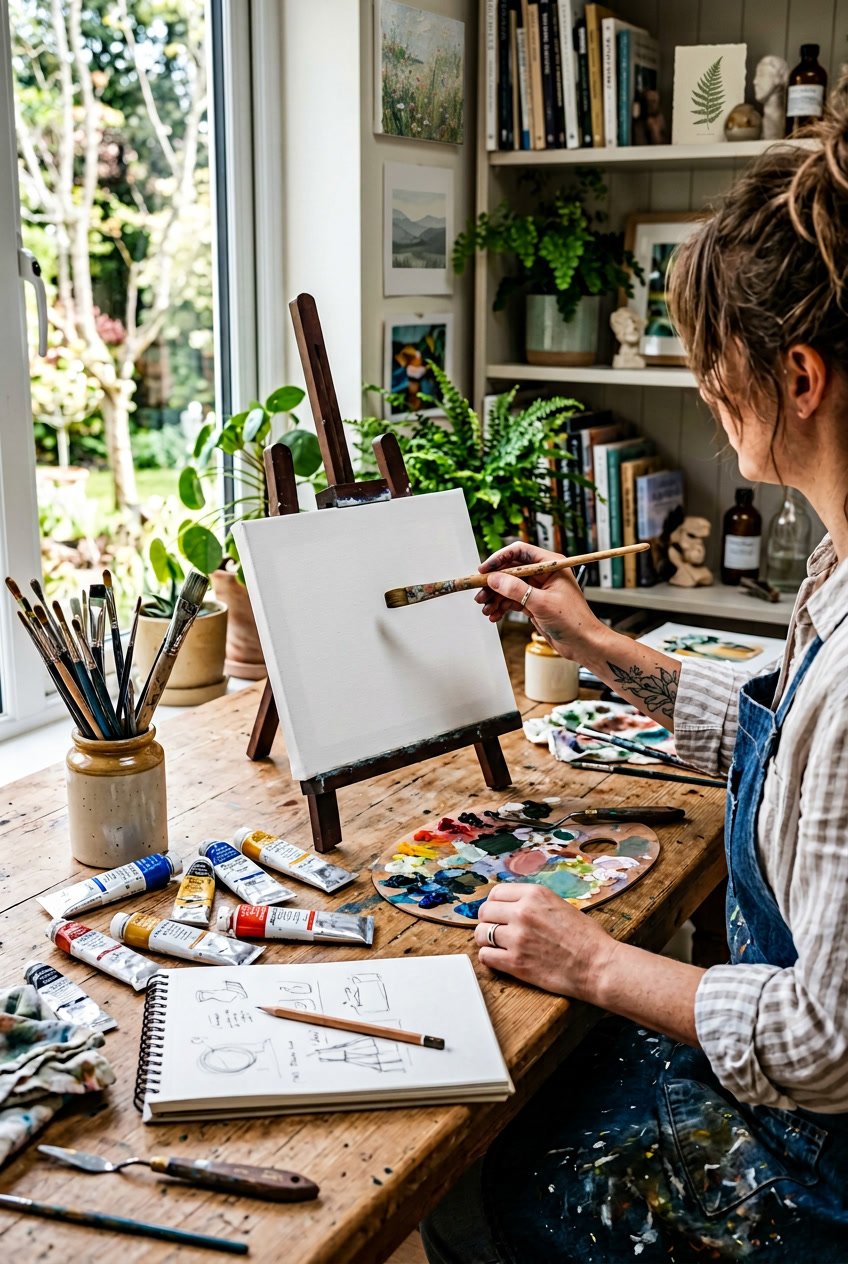
You’ll find concrete themes, exercises, and places to look when your ideas dry up. The answers below list specific prompts, habits, and quick techniques you can try right now.
What are some inspirational themes for a painting project?
Pick themes tied to places, objects, or feelings you know well. Maybe a rainy city street at dusk, a kitchen still life with fruit and a patterned cloth, or a memory from childhood.
Try time-of-day studies—sunrise, golden hour—or seasonal scenes like snowy lanes or spring blossoms. Focus on emotions, too: empty chairs for loneliness, or loose, bright color for joy.
How can I overcome painter’s block and find inspiration?
Change up your routine for a bit to reset your focus. Paint with a different medium for half an hour, or set a 20-minute timer and just finish any small piece—no judging.
Limit your choices with a prompt or palette restriction. Paint only in two colors, or copy a photo in one sitting. These limits cut the pressure and get you moving.
What techniques can I use to generate new painting ideas?
Use thumbnails—make lots of tiny sketches to explore compositions fast. Flip photos upside down to spot cool shapes and values without getting stuck on details.
Mix your reference sources. Combine a landscape photo with fabric patterns, or drop a still life object into a surreal sky. Collage photos and sketches for hybrid ideas.
Can you suggest any creative exercises for generating painting concepts?
Try a 10-minute speed painting focused on mood, not detail. It forces fast choices and opens up surprising directions.
Make a prompt jar: write 50 small ideas (objects, places, feelings) on slips and pick one at random. Or try a theme week—five paintings on “windows” or “hands” to dig deeper.
Where can artists look for unexpected sources of inspiration?
Look in everyday scenes—a grocery aisle, bus stop, or a pile of tools in the shed. Ordinary setups often have strong shapes and color contrasts.
Browse non-art places too—architecture photos, botanical guides, music playlists, even recipes. Mix these with visual references and you’ll spark fresh concepts.
What are some methods to spark creativity in painting?
Try setting limits—like restricting the size of your canvas, sticking to just a few colors, or giving yourself a time cap. Weirdly enough, these kinds of constraints can push you to get creative with composition and gesture instead of chasing perfection.
Sometimes I’ll grab a random prompt or swap ideas with another artist. You might want to start a series that revolves around just one simple thing—a tree, a door, maybe a pair of hands.
Repetition helps, but so does bouncing ideas off someone else. Keeps things moving, you know?